

Imagine the warm, woodsy smell of freshly foraged honey mushrooms mingling with sizzling onions and cumin, the steam lifting from a pot of tender rice that’s soaked up every drop of flavor. That’s what a good bowl of Pilaf with honey mushrooms offers: honest comfort, a little wildness, and the kind of depth that makes you want to close your eyes and take another bite. Stick around and I’ll walk you through where this dish comes from, what makes it special, and exactly how to cook it so your kitchen smells like a Sunday market in an hour.
- Country of origin Pilaf with honey mushrooms
- History Pilaf with honey mushrooms
- Interesting facts about Pilaf with honey mushrooms
- Nutritional value Pilaf with honey mushrooms
- Popularity in different countries Pilaf with honey mushrooms
- The best step-by-step cooking recipe for Pilaf with honey mushrooms
- Ingredients
- Preparation and cooking steps
- Tips for success
- Final notes on Pilaf with honey mushrooms
Country of origin Pilaf with honey mushrooms
Pilaf itself traces back to Central Asia, where rice cooked with meat and spices became a cornerstone of regional cooking. The version known as Pilaf with honey mushrooms is an adaptation that grew where forests meet farms — mainly Eastern Europe and parts of the Caucasus. In those regions, rice and pilaf techniques arrived by trade and migration, while local mushroom foraging fed into home kitchens. The result is a hybrid: a Central-Asian rice method married to the forest flavors of Russia, Ukraine, Poland and nearby countries.
History Pilaf with honey mushrooms
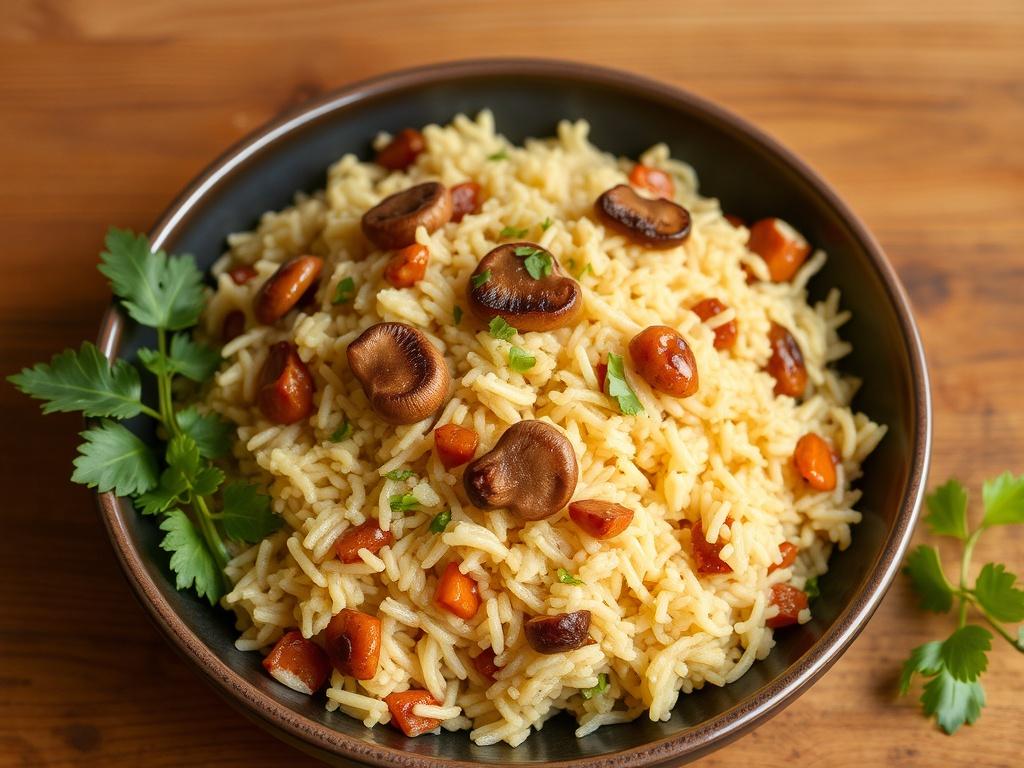
Home cooks have always adapted pilaf to what’s on hand, so when wild honey mushrooms show up in late summer and autumn, they end up turning many a simple rice dish into something memorable. Villagers who gathered mushrooms for winter preserves also started frying and mixing them into rice for a hearty one-pot meal. Over generations, small tweaks — frying mushrooms first, parboiling to remove harshness, adding regional spices — became traditions. In 20th-century cookbooks from the region you’ll find mushroom pilafs alongside meat-based plovs, reflecting both seasonal thrift and taste.
Interesting facts about Pilaf with honey mushrooms
- “Honey mushroom” often refers to a group of Armillaria species; they grow in clusters at the base of trees and have a mild, slightly sweet note when cooked properly.
- Foragers prize them, but they require careful cleaning and cooking. Some people react to undercooked honey mushrooms, so traditional recipes call for parboiling or thorough frying.
- Pilaf goes by many names — plov, pilau, pulao — and each culture gives it a twist. The mushroom version is a seasonally popular vegetarian adaptation in places where wild fungi are plentiful.
- Because mushrooms absorb liquid and flavor well, they act like tiny flavor sponges in the rice, making simple spices sing.
Nutritional value Pilaf with honey mushrooms
This dish balances carbohydrate energy from rice with the nutritional contributions of mushrooms and vegetables. Honey mushrooms bring protein, dietary fiber, B vitamins and minerals such as potassium and selenium. Vegetables add fiber and micronutrients, while a modest amount of oil provides satiety. Below is an approximate nutritional snapshot for one serving (about 300–350 g) of Pilaf with honey mushrooms; values vary with ingredients and portion size.
| Nutrient | Approximate amount per serving |
|---|---|
| Calories | 350–500 kcal |
| Carbohydrates | 45–60 g |
| Protein | 8–15 g |
| Fat | 8–15 g (depends on oil or added butter) |
| Fiber | 3–6 g |
Popularity in different countries Pilaf with honey mushrooms
Pilaf with honey mushrooms is particularly cherished in countries where mushroom foraging is a social ritual — think Russia, Ukraine, Poland and parts of the Baltics. In those places, mushroom season sparks markets, family trips to the woods, and kitchen projects that feed households through winter. Elsewhere, similar dishes appear where rice meets local fungi — in Turkish and Caucasian kitchens mushrooms are used in pilafs too, though often alongside different spice profiles or with added meats.
The best step-by-step cooking recipe for Pilaf with honey mushrooms
Here’s a reliable, home-friendly recipe that highlights the honey mushrooms without overpowering the rice. It serves 4.
Ingredients
| Ingredient | Amount |
|---|---|
| Long-grain rice (basmati or similar) | 2 cups |
| Fresh honey mushrooms, cleaned | 500 g (about 1 lb) |
| Onion, finely chopped | 1 large |
| Carrot, julienned or grated | 1 large |
| Garlic, minced | 2–3 cloves |
| Vegetable oil or butter | 3–4 tbsp |
| Hot vegetable or chicken stock | 4 cups (adjust as rice variety requires) |
| Cumin seeds or ground cumin | 1 tsp (or to taste) |
| Salt and black pepper | To taste |
| Fresh herbs (parsley, dill) optional | To finish |
Preparation and cooking steps
- Clean mushrooms: Trim stems, separate clusters and rinse briefly. To reduce bitterness and any potential digestive issues, parboil the honey mushrooms in salted water for 10–12 minutes, then drain and pat dry.
- Rinse rice in cold water until the water runs clear. Soak for 15–20 minutes if you have time, then drain.
- Heat 2 tbsp oil in a wide heavy pot. Add onions and cook gently until translucent and lightly golden. Add carrots and cook 3–4 minutes.
- Add the parboiled mushrooms to the pot. Increase heat and sauté until they release moisture and begin to brown — about 6–8 minutes. Season with salt, pepper and cumin.
- Add the drained rice, stirring to coat grains with oil and to mix with vegetables for a minute. This step helps keep grains separate later.
- Pour in hot stock. The ratio should match your rice type (typical long-grain is about 1:2 rice to liquid). Bring to a boil, then reduce to the lowest simmer. Cover tightly and cook undisturbed for 15–20 minutes until liquid is absorbed and rice is tender.
- Turn off heat and let the pilaf sit covered for 8–10 minutes. Fluff gently with a fork, adjust seasoning, and finish with chopped fresh herbs and a drizzle of butter or oil if you like.
Tips for success
- Parboiling honey mushrooms is an old, sensible trick. It removes some bitterness and helps ensure digestibility for people sensitive to wild fungi.
- Use a wide pot with a tight lid so steam distributes evenly. Avoid stirring while simmering — it makes rice gluey.
- Customize: add toasted nuts for texture, a squeeze of lemon for brightness, or small cubes of smoked meat if you want a heartier dish.
Final notes on Pilaf with honey mushrooms
Pilaf with honey mushrooms is one of those dishes that tastes like home even if you’ve never had it before. It’s a clever balance of economy and flavor: simple staples elevated by seasonal bounty and slow, careful cooking. Try it on a damp afternoon and you’ll understand why families have been making versions of this meal for generations.


